Wednesday, August 21, 2013

Medtronic Earnings Call

The Chump portfolio maintains a full position in medical device maker Medtronic (MDT).  The price of the stock has reached "fair value" based on FAST Graphs, so I trimmed the position a bit late last week on strength.


Earnings were announced this week and stock dropped a bit;  revenue was at the low end of the range forecasted, and eps were right on target.  I'll hold the full position until the stock gets overvalued.

Here is a highlight from the earnings call, which can be found here:

 http://seekingalpha.com/article/1647222-medtronics-ceo-discusses-f1q-2014-results-earnings-call-transcript

"Over the next five years, we expect to generate over $25 billion of free cash flow. We remain committed to returning 50% of this to our shareholders through dividends and share repurchases, a commitment level we believe is appropriate given our current mix of U.S. and international free cash flow. We are constrained by U.S tax policy which creates a negative incentive for us to repatriate cash to the U.S. the remaining 50% gives us the flexibility to make the necessary investments for sustainable growth. We continue to be very disciplined in how we deploy our capital with a strong focus on returns. As we have said in the past, we expect any M&A transaction to surpass our mid-teens risk-adjusted hurdle rate and we do not expect these investments to be dilutive to shareholder EPS growth expectations."

Best,

Chump

Monday, August 12, 2013

High Earnings Growth Screen for Grox01

In a comment from my previous post, Grox01 asked that I run a screen for fast earnings growers > 20% over the next five years.  This, of course, yields many companies, so I added some additional screening metrics:


  • 30% eps growth forecast for 5 years
  • PE of 15 or less
  • Beta of less than 2.0
  • Stock price of at least $5
  • Dividend of at least 2% (what can I say, I love dividends)
Here are the results:


The list is worth some additional due diligence.  Grox01, please let us know what you learn!

Best,

Chump

Friday, August 9, 2013

Chump Portfolio Update August 9, 2013 - Busy Week

1st, some good reading.  I'm currently reading Seth Klarmon's "Margin of Safety" recommended in a recent post by Tim McAleenan of Seeking Alpha.  A link to the book online can be found here:

http://www.my10000dollars.com/MS.pdf

I'm not finished yet, but I really like the book.  Below is passage I found quite interesting and contrary to what I thought previously:


I've gotten a bit complacent with the Chump IRA the past several months, remaining fully invested, and letting the portfolio run.  Returns have been good, but I need to trim or sell off positions that become overvalued.  I've hesitated to do this "robotically,"  letting my fondness for some of my stocks coupled with greed win the day.  Time to stick to my rules, and downsize some of the overpriced positions and get some cash back into the portfolio.

With this in mind, I trimmed down positions in JNJ, DOV and sold my remaining shares of CMI entirely.  Here are the FAST Graphs for DOV and JNJ respectively:


In both cases, I bought shares when price was well below the orange earnings line, and am trimming now with prices well above the line.  Pretty simple.  Both of these have grown into large positions, well over 4% each.  I'm trimming about 10% off of each, which leaves me overweight in both.  I'm going to think about further reductions next week (hey, one step at a time, I HATE selling good companies).  The chart for CMI isn't as clear cut:


I purchased CMI last summer at around $94 per share, and sold off my remaining position today for nice gain.  I like CMI, and it's now reached fair value.  When I bought it, it was well under value.  I never intended CMI to be a "core" position in the portfolio (unlike dividend champions JNJ and DOV), and EPS are down two straight years.  Further, I've been swapping CMI for Deere (DE), with a better brand, growing earnings, and better yield of 2.5% vs. 2.0% for CMI.

I closed CMI today, and added to my DE position.  I now have a full position in DE, a chart for Deere is shown below:


At today's price of $82.32, DE is undervalued, and a better opportunity than CMI.  In addition to my purchase of DE, I also started a position in IBM.  A FAST Graph for IBM is shown below:


IBM is a solid blue chip company, is raising the dividend every year, though it's only 2% today, and is now in an undervalue situation at today's price.  I'll look to add to the position on dips in the coming weeks/months.  To fund this position, I sold some INTC this week.  I have a large position, and hold it in a taxable account as well.  I'm reducing my exposure to INTC in favor of IBM.

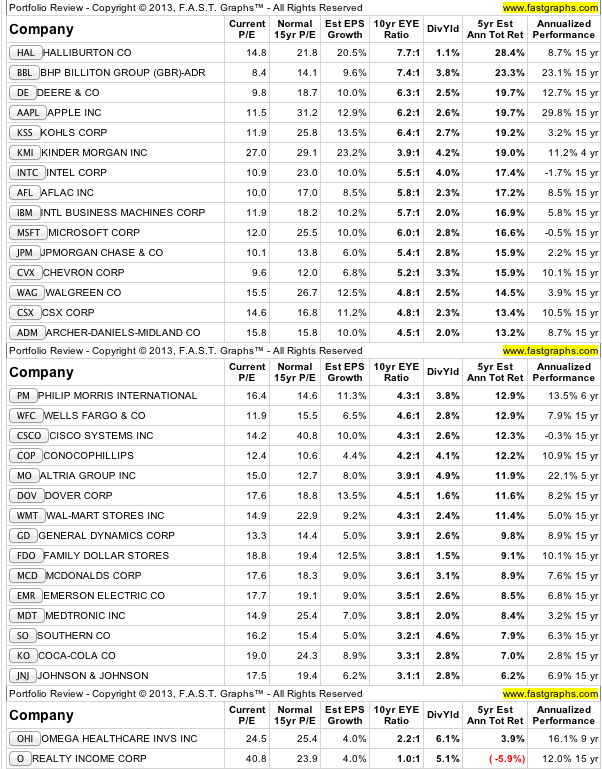
After a busy week, here is a summary of the Chump portfolio, via FAST Graph, with some useful metrics, ranked by forecasted total return:


That's all for now,

Chump


Thursday, August 8, 2013

Adding IBM

Been watching GE and IBM for the portfolio.  IBM is down over 10% from recent highs, has nice growth in EPS and dividends, and has reached a point of undervaluation.  I started a 1/4 position today at $187.65.  Here are few FAST Graphs:


Today's price of $188 is well below the earnings justified value (PE=15), and the historical valuation over the past 20 years.  Looking at the past 6 years:


Since the great recession of 2008/2009, the normal PE level is 13.8 vs. today's blended PE level of 11.9.  Looking at dividends and growth estimates:


IBM is growing dividends at 17% per year (CAGR), and analysts are projecting 10% growth in EPS over the next 5 years.

I trimmed some DOV and JNJ over the past week to pay for this acquisition;  both are large positions reaching overvaluation levels.

Best,

Chump

Wednesday, July 24, 2013

Nice Covered Call Example

I don't do much option trading, but I'd like to start writing covered calls and puts on certain stocks.  Stocks trading at high valuations, or trading sideways for long periods tend to be good candidates for covered calls;  where someone pays you a few bucks for the option to buy your shares in the future at a higher price than today.  The risk to the me is that I will sell my shares at a higher price than today; thus, I'll part with my dividend producing asset.

Here is a nice example from Dr. Paul Price:

New post on MarketShadows

A Covered Call Concept

by Dr. Paul Price

A Covered Call Concept

Everyone loves to get something for nothing. When covered calls end up expiring worthless that is exactly what happens. The writer (seller) received money for the call premium. An option that goes unused means the  seller ‘won’  without giving up anything. 
Many people think that seeing short calls expire is the ‘best case’ result. They are wrong. To understand why simply do the math.
Assume we own 100 XYZ Corporation  which now  trades at $45 per share.  Pretend the bid on the October $50 calls is $2. Selling one covered call contract at that price brings in $2 x 100 shares = $200.
If XYZ finishes at $45, unchanged from its inception date price, on expiration Friday:
                       (Not)_The_Best-Case_Scenario
We started with 100 XYZ shares worth $4,500. When the trade concluded we finished holding the original 100 XYZ shares, still worth $4,500, plus the $200 from the call premium = $4,700 in total value.
If the underlying shares had declined in price by anything greater than the $2 per share our position would have less total value than we started with as of the trade inception date.
The call money received was 100% profit. Did that really represent the maximum possible profit?
Consider the result achieved if XYZ ends at $50 or above on the option’s expiration date.
 Better-Case_Scenario_for_Covered_Calls
The call writer would be forced to deliver 100 XYZ shares when the option is exercised. The option owner would then pay him $50 x 100 shares = $5,000.  The call seller would also have the $200 from the call premium received.
Final position = No shares + $5,200 of cash.
Total Value = $5,200.
Which would you rather have on the option expiration date… $4,700 or $5,200?
Sure, it rankles if the underlying shock shoots to well above the chosen strike. Call sellers have capped their upside.  They will miss out on pocketing the full  move. Do not sell covered calls at strike prices lower than where you would be willing to part with your shares.
The ‘risk’ in covered call writing is exactly the same one you take whenever you sell any stock. There is always a chance that those shares could go higher afterwards.
The key concept is simple.
Once you have sold covered calls … seeing the option exercised always delivers your best-case result.
Dr. Paul Price | July 23, 2013 at 7:11 am | Categories: Education, Options, Value Investing | URL:http://wp.me/p2soa2-7TkY

Tuesday, July 23, 2013

Halliburton Notes

HAL announced EPS a penny above expectations, and revenue slightly ahead of expectations.  Both are down vs. same quarter last year, but that's true throughout the natural gas industry.  Decent report card.  I'm holding, hoping for a nice dividend increase.


Analyst Actions: Halliburton Keeps Outperform, Target Lifted $2 at Credit Suisse; Shares Up Near 2%, Nearer 52 Week Highs

02:22 PM EDT, 07/23/2013 (MidnightTrader) -- Credit Suisse says: "No Good Performance Goes Unpunished. HAL did well this quarter and delivered on its promises, but this did not show up in the stock price-a buying opportunity. Activity is strong-frac stages are on par with 3Q12, the latest peak in Oilfield Service activity. Growth in North America (NAM) is the primary investor concern. Recovery in Canada and the Gulf Of Mexico (GoM) will drive NAM revenues higher in 3Q13, with service intensity and rig efficiency aiding onshore; but given a record frac stage run rate, significant upside will depend on pricing which should kick-in sometime next year. The outlook on fundamentals remains strong and we are raising 2013 EPS to $3.22 from$3.21 and 2014 to $4.26 from $4.08, and TP to $55 (from $53)."
Not Just a NAM OFS Company. "HAL delivered leading YoY international revenue growth for the 5th consecutive quarter (+14% YoY). 2Q13 international op income was 48% of EBIT. Eastern Hemisphere also grew at the top of the peer group, YoY revenue and EBIT were +16% and +23%, respectively, which even outpaced SLB's impressive Eastern Hemisphere performance of +12% revs and +18% EBIT and BHI's +12% rev and +9% EBIT YoY. HAL mentioned a few recent wins that will help propel its strength in the region including a $500mm fluids contract in Malaysia, an offshore cementing contract, and a $100mm five year contract in the North Sea. We project Eastern Hemisphere YoY growth to be 20% for sales and 27% for EBIT in 3Q13."

Long Term View Intact; Buy It. "We reiterate our Outperform rating and are increasing our TP to $55 from $53; our target continues to be based on 6.5x our 2014 EBITDA estimate (which is now $8.1B). HAL continues to trade at a discount to its closest peer: 29% and 24% on EV/Ebitda and P/E respectively, a discount we do not believe is justifiable given HAL's superior returns and international revenue growth."
Price: 45.90, Change: +0.82, Percent Change: +1.8


http://www.midnighttrader.com


Tuesday, July 16, 2013

Johnson & Johnson in the WSJ Today - Good Quarter

New Drugs Lift J&J's Quarter

Earnings More Than Double for the Quarter


By 
  • JONATHAN D. ROCKOFF
  • Johnson & Johnson JNJ -0.02% said Tuesday that its second-quarter earnings more than doubled to $3.8 billion, as the health-products company benefited from fewer special charges and surging sales for new prescription drugs that the company is starting to roll out.
    The $17.9 billion in sales that the New Brunswick, N.J., company reported during the quarter, an 8.5% increase over the period a year earlier, was driven partly by the growth of new medicines, such as prostate-cancer treatment Zytiga and hepatitis C treatment Incivo. J&J has launched 11 new drugs since 2009, and says it expects to seek approval of 10 more by 2017.
    "The year is off to a strong start," J&J Chief Executive Alex Gorsky said.

    Now Reporting

    Track the performances of 150 companies as they report and compare their results with analysts' estimates. Sort by date and industry.
    [image]
    J&J's medical-devices business, the company's largest segment by sales, benefited from the $21 billion acquisition last year of trauma-device maker Synthes. The device unit's sales grew 9.6% to $7.19 billion, though executives acknowledged that the business faced pricing pressures and other challenges in the U.S.
    Charges amounting to $2.2 billion related to the integration of Synthes, as well as funds reserved for litigation expenses, weighed down J&J's results for the second quarter last year.
    J&J's $3.8 billion profit in the current second quarter, or $1.33 a share, was up from $1.41 billion, or 50 cents a share, a year earlier. Excluding certain items—such as a gain related to the sale of Elan Corp.'s DRX.DB -1.07% American depositary shares, acquisition-related costs and litigation impacts—adjusted per-share earnings rose to $1.48 from $1.30.
    Analysts polled by Thomson Reuters had projected earnings of $1.39 a share on revenue of $17.71 billion.
    Shares of J&J rose 16 cents to $90.56 in late morning trading Tuesday. The stock is up about 29% this year.
    J&J has been struggling with the recall of iconic products like Tylenol pain and cold medicines, and the company announced more recalls in the quarter. Yet the company began returning recalled products to store shelves in the U.S., notching $290 million in over-the-counter sales in the U.S., a 17% increase from the year-earlier period.
    "We're making good progress restoring our over-the-counter products to store shelves," said Sandra Peterson, the J&J executive who oversees the company's consumer group. Overall, sales in the company's consumer unit grew 1.1% to $3.7 billion.
    Like its rivals, J&J has sought to move beyond the onset of generic competition for top-selling prescription drugs by restocking its portfolio. In the quarter, J&J reported $7 billion in pharmaceutical sales, a 12% jump from the year-earlier period.
    Executives said new drug launches made J&J the fastest-growing drug maker in the U.S., though the company has encountered setbacks, notably the failure of an infused version of an experimental treatment for Alzheimer's disease. J&J and partner PfizerInc. PFE +0.09% discontinued development of the remaining, injectable version of that therapy, bapineuzumab, J&J said Tuesday.
    Among the new drugs that J&J is counting on to drive further growth is ibrutinib, an experimental blood-cancer treatment that last week was submitted for U.S. approval. In an effort to complement Zytiga, J&J said last month that it would pay $650 million upfront to buy privately held Aragon Pharmaceuticals Inc. and its experimental prostate-cancer treatment in midstage development.
    —Tess Stynes contributed to this article.